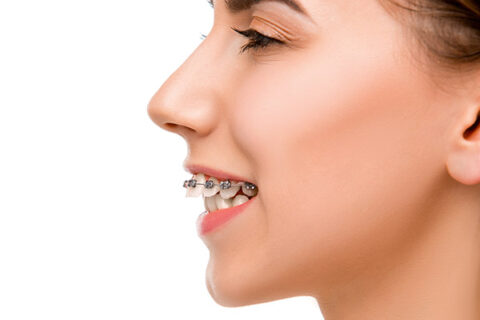
An orthodontist can help to fix bite issues like an overbite. The term refers to your upper teeth extending further past the lower set. The condition is commonly referred to as “buck teeth.” How far your top teeth protrude further than the lower set determines the severity of the condition.
An overbite should not be confused with an overjet. Both involve the front set protruding past the lower set, but the upper set of teeth protrude at an angle with overjets. Overbites can be caused by various factors like genetics, missing teeth, or a person’s jaw shape. Childhood habits like thumb sucking, tongue thrusting, and long-term bottle use can also lead to the condition.
How an orthodontist treats overbites
Some of the treatment options our orthodontist might recommend for patients with overbites include:
1. Braces
Traditional metal braces are the standard when it comes to treating severe overbites. These appliances can also be used to address a wide range of teeth alignment issues like crooked teeth or a misaligned jaw.
Braces consist of brackets that are cemented to each of the patient’s teeth and wires that connect brackets on each dental arch. Tightening these wires creates a gentle force that slowly pushes the wearer’s teeth to a more suitable position.
Once the patient’s teeth have been moved to the targeted positions, bands, springs, and coils can then be added to the appliance to help align and shift the patient’s jaw.
Braces are fixed appliances, so they cannot be removed at home. Treatment times with braces can be anywhere between 12 to 36 months. The patient comes in for inspections and adjustments monthly to ensure things are running smoothly with their treatment.
Patient’s who have their overbites addressed with braces will probably have to wear a retainer after their treatment. Retainers help to keep teeth in their new positions.
2. Clear aligners
Clear aligners provide a less visible way to address an overbite. However, these devices can only be used to correct mild to moderate overbites caused by poor teeth positioning. Overbites caused by jaw misalignment cannot be fixed with clear aligners. Other devices like braces are needed to help improve the alignment of the patient’s jaw.
Treatment with clear aligners involves getting several sets of trays at the start of their treatment. Each set is worn for a couple of weeks before being switched out with another that takes over from where it stops. The patient’s teeth should be at the targeted position by the time they are done with all their trays.
Treatment with clear aligners tends to be the more convenient approach since these appliances can be easily removed and reinserted into the mouth. The aligners do not get in the way of meals or oral hygiene. The most challenging thing for most people who wear clear aligners is remembering to wear their aligner trays for 22 hours daily.
We can fix your overbite
Ready for a smile you can be proud of? Call or visit our Hoboken clinic to set up an appointment with our orthodontist.
Request an appointment or call Mile Square Orthodontics at 201-537-3535 for an appointment in our Hoboken office.
Related Posts
You can enjoy Halloween with braces. Choose soft, plain chocolate and treats that melt easily, and skip anything hard, sticky, chewy, or crunchy, like caramels, taffy, gummies, hard candy, gum, and popcorn. Brush soon after, and call us if a bracket loosens.October is a big month for orthodontic patients. The American Association of Orthodontists marks…
Ceramic and metal braces move teeth the same way, with brackets and a wire. The difference is appearance and durability. Ceramic braces use tooth-colored brackets that are harder to notice, while metal braces are stronger and often the better fit for severe or complex cases. The right choice depends on your bite, goals and lifestyle.…
Yes, you can play sports with braces. Low-contact activities like running, swimming and dancing are safe at every stage of treatment. For contact sports and sports involving a ball, wear a mouthguard designed to fit around braces. It protects the teeth, lips and cheeks, and keeps brackets and wires from breaking or bending. Fall is…